
Extralt
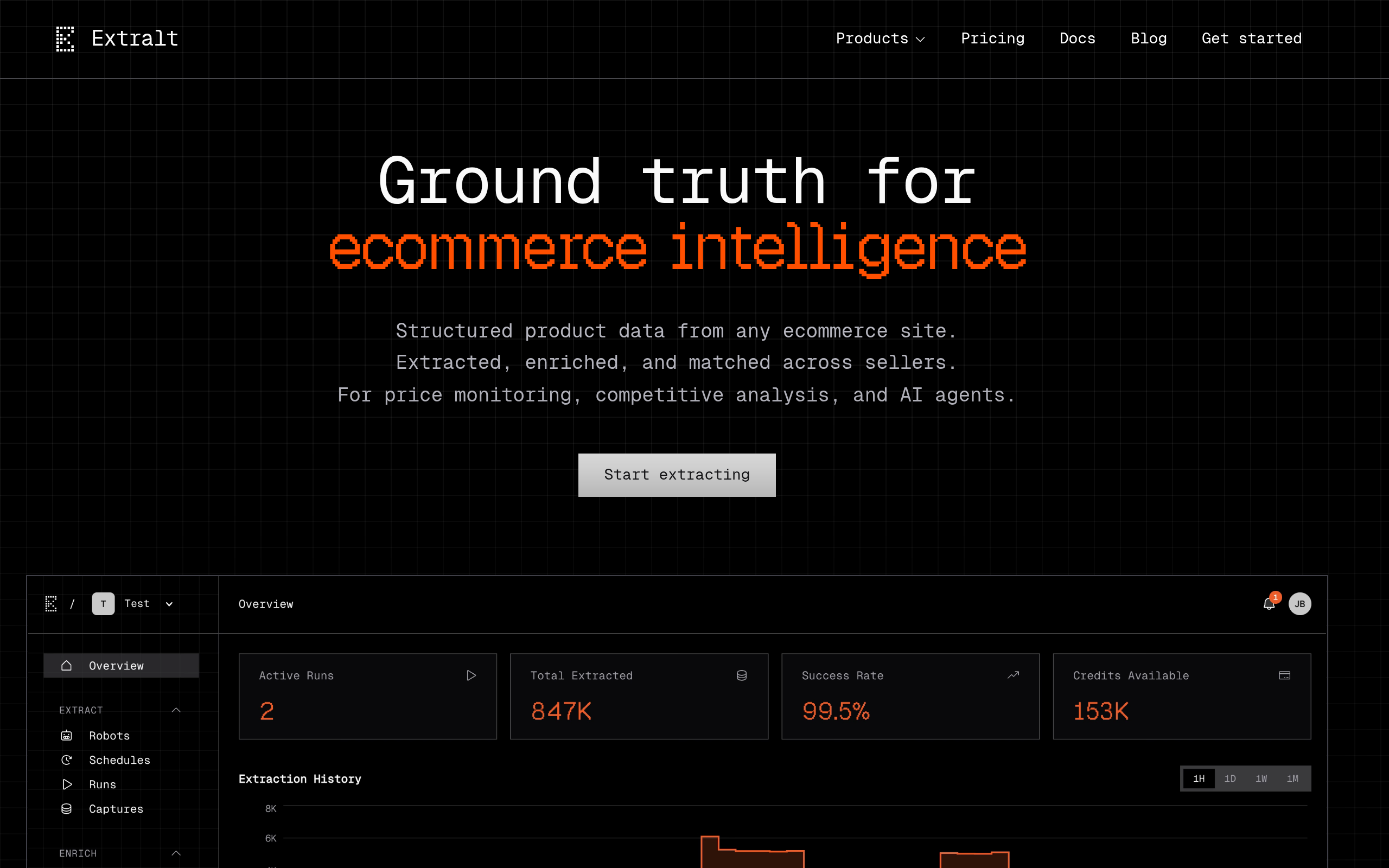
Ground truth for ecommerce intelligence. Structured product data from any ecommerce site. Extracted, enriched, and matched across sellers. For price m
About
Most ecommerce data is locked inside walled gardens or filtered through merchant feeds. Sellers report what they want you to see. Extralt gets what's actually there. We extract structured product data from any ecommerce site, normalize it to a universal schema, and match the same product across sellers. Four stages: Extract crawls sites and produces consistent structured data. Enrich translates to English, classifies with the Shopify taxonomy, pulls out category-specific attributes, and matches products across sellers. Extend finds the same product on different sites, surfaces alternatives, and links complements. Explore lets you search, compare prices, and run analytics across everything. You pay for Extract and Enrich. Extend and Explore are free. We built the extraction engine because scraping ecommerce is a maintenance nightmare. Traditional scrapers break when sites change layout. AI scrapers adapt but cost too much to run on every page. So we use AI once to generate each crawler, compile it to Rust, and run native code from there. Fast, nothing to maintain. Today, teams use it for competitor pricing, MAP compliance, catalog benchmarking, market research, and building data products on our API. Over time, AI agents will need this data too. Checkout protocols like OpenAI's ACP and Google's UCP handle how agents pay for things, but both only see products from merchants who submit feeds. The rest of the web is invisible to them. Extralt covers that. Independent product discovery from the open web, not merchant self-reporting.
Key Features
Extract — Scalable ecommerce crawling
Prebuilt and quickly generated crawlers compiled to native Rust code for high-speed, low-maintenance extraction of complete product catalogs, pricing, and availability from any ecommerce site.
Enrich — Normalization & attribute extraction
Translate content to English, classify products to industry-standard taxonomies (e.g., Shopify), extract category-specific attributes (size, color, SKU), and produce canonical product records ready for matching and analytics.
Extend — Cross-seller matching & relationships
Link the same product across multiple sellers, surface alternate listings, recommend alternative products and complements, and build a cross-catalog product graph.
Explore — Search, compare, and analyze
Query single products, traverse relationships, run market-wide aggregations and price-distribution analytics, and export results via API, JSON, CSV or Parquet for dashboards and data products.
How to Use Extralt
1) Sign up and get API credentials or start a free trial. 2) Select target site(s) or URLs—use Extralt’s prebuilt crawler library or request a new site to be generated. 3) Run Extract to capture raw product pages (1 credit/URL) and optionally run Enrich (1 credit/capture) to normalize, translate, and extract attributes. 4) Use Extend and Explore (free) to match products across sellers, find alternatives/complements, run market queries, and export results via API or file formats.