
Datamagnet
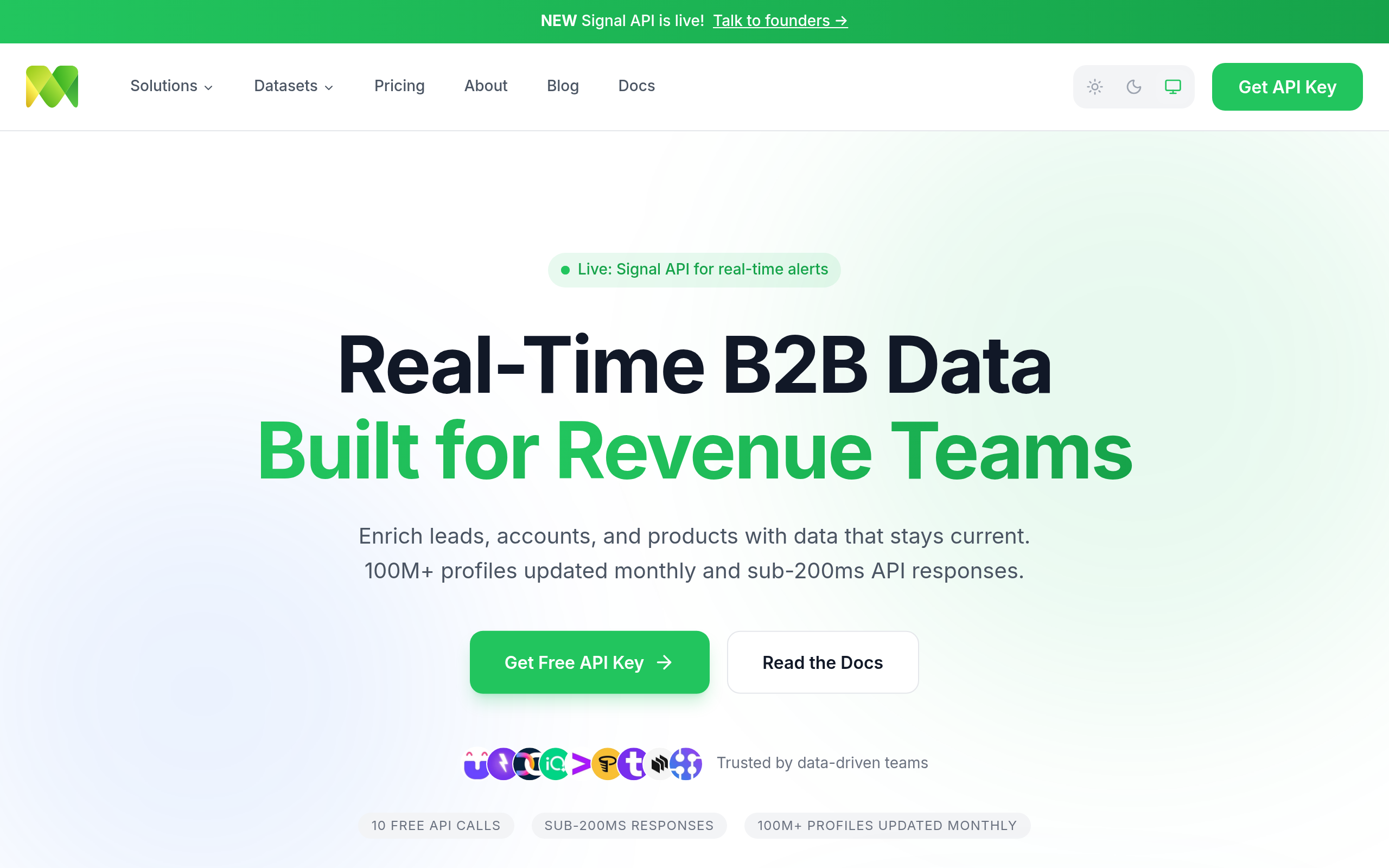
DataMagnet is a developer-first real-time data enrichment API that converts LinkedIn URLs, emails, or domains into structured people and company data.
About
Datamagnet is a developer-first, real-time data infrastructure platform designed to provide structured, continuously updated people and company intelligence at web scale. It primarily targets SaaS platforms, revenue teams, and data-driven applications that require high-quality enrichment, monitoring, and signal-based automation. At its core, Datamagnet operates as a high-performance API layer that transforms unstructured web data—particularly from professional networks such as LinkedIn—into normalized, machine-readable JSON objects. The platform supports both on-demand enrichment and event-driven workflows, enabling systems to fetch or receive updates about individuals and organizations in near real time. Its architecture emphasizes low-latency responses (sub-200ms) and high availability, making it suitable for production-grade applications with strict performance requirements. A key technical capability of Datamagnet is real-time enrichment. Given an identifier such as a LinkedIn URL, the API resolves and returns structured attributes including professional metadata, company details, activity signals, and engagement data. This enrichment pipeline is optimized for high match rates and consistent schema output, allowing seamless ingestion into CRMs, analytics systems, or downstream data pipelines. The platform also introduces a signals-based data layer, which streams actionable events such as job changes, funding rounds, hiring spikes, and content activity. These signals are delivered via flexible mechanisms including REST APIs, polling endpoints, and webhook subscriptions. This event-driven design enables customers to build reactive systems—for example, triggering outbound sales workflows when a decision-maker changes roles or when a company raises funding.
Key Features
Real-time Enrichment API
Resolve LinkedIn URLs, emails, or domains into normalized people and company JSON objects with sub-200ms response times for production-grade, on-demand enrichment.
Signals & Event Streaming
Stream high-signal events (job changes, funding, hiring spikes, posts/activity) via webhooks, polling endpoints, or REST APIs to trigger reactive workflows.
Clean, Consistent Schema
Normalized, machine-readable output fields for people and companies that simplify ingestion into CRMs, analytics systems, and data pipelines.
Flexible Delivery & Ops-ready
Consume data via REST APIs, webhook subscriptions, or bulk flat-file snapshots with high availability and predictable latency for scale.
Web-scale Coverage & Freshness
Large coverage (hundreds of millions to billions of profiles/companies) with continuous monthly refreshes and high match rates to keep customer data current.
How to Use Datamagnet
1) Get an API key: Sign up at the Datamagnet dashboard and obtain your free trial API key. 2) Make an enrichment request: Call the People or Company API endpoint (e.g., POST /api/v1/linkedin/person) providing a LinkedIn URL, email, or domain to receive a normalized JSON profile. 3) Ingest and act: Parse the returned fields and sync them into your CRM, data warehouse, or product; use attributes to autofill records, deduplicate, or enrich analytics. 4) Subscribe to signals: Register webhooks or use polling endpoints to receive real-time events (job changes, funding, hiring spikes) and wire those events into workflows (outbound outreach, alerts, automated routing).