
Agyn
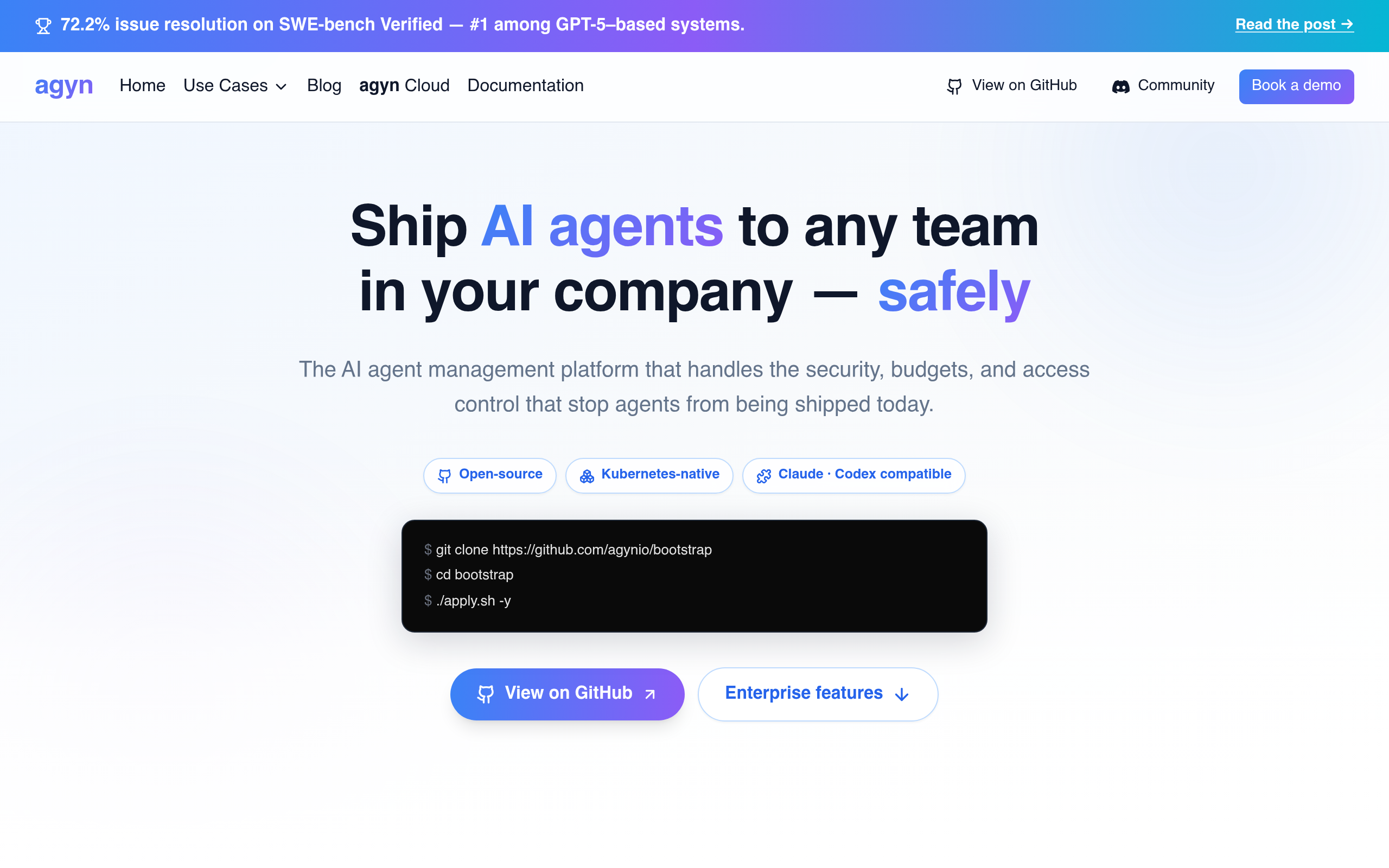
Open-source platform that lets every team run AI agents — with isolation, spend caps, RBAC, and audit logs built in.
About
Agyn is the open-source management layer for AI agents — it takes agents off employee laptops and runs them safely across the whole organization. Every agent runs in an isolated sandbox. Secrets stay hidden from the model. Each team gets its own spend cap, role-based access, and a complete audit trail. Works with any agent (Claude Code, Codex, custom builds) and any model. Self-hosted or cloud. Built for the moment AI stops being a side project and starts touching production data — when security, finance, and IT need real controls before they say yes. Non-technical teams get agents they can actually use. Engineering keeps oversight. Finance sees every dollar spent on tokens. IT stops worrying about shadow AI. If your company is moving from agent experiments to agents in production, Agyn is the layer that makes it possible.
Key Features
Isolated Sandboxes
Run every agent in its own sandboxed environment (VPC/VPN support) so agents can access internal services securely without exposing local machines or broad network access.
Secrets & Prompt‑injection Defense
Keep secrets hidden from models, enforce least‑privilege access, and sanitize agent inputs/outputs with a policy agent that inspects tool calls to prevent data leaks and prompt injection.
RBAC, Audit Logs & Policy Gates
Role-based access control and a policy gate provide per-team and per-agent permissions plus a complete audit trail of actions and decisions for compliance and security reviews.
Per-Agent Budgets & Cost Attribution
Set spend caps, usage alerts and cost reporting per agent, team and workflow so finance can monitor and control token/API spend.
GitOps & Multi‑environment Deployments
Declare agents, sandboxes, policies, MCPs and prompts as code (Terraform-style) for reproducible, auditable deployments with instant rollback across environments.
How to Use Agyn
1) Deploy: Clone the agyn bootstrap repo and run the installer (or follow the cloud/self-hosted docs) to deploy into your Kubernetes cluster or VPC. 2) Define agents in code: Add agent, sandbox, policy and tool definitions to your repo (agents.tf, sandbox.tf, policy.tf, etc.) and apply via GitOps so agents are declared and versioned. 3) Configure security & budgets: Configure secret vault integration, static policies/policy agent, RBAC groups and per-agent/team budgets and alerts before enabling agents. 4) Ship & monitor: Invite team members, deploy agents to the target network, monitor live policy decisions, usage, costs and audit logs; iterate on policies and agent skills as needed.