
act101
tree-based navigation, semantic refactoring, codebase analysis, and language porting tools for coding agents supporting 163 grammars
About
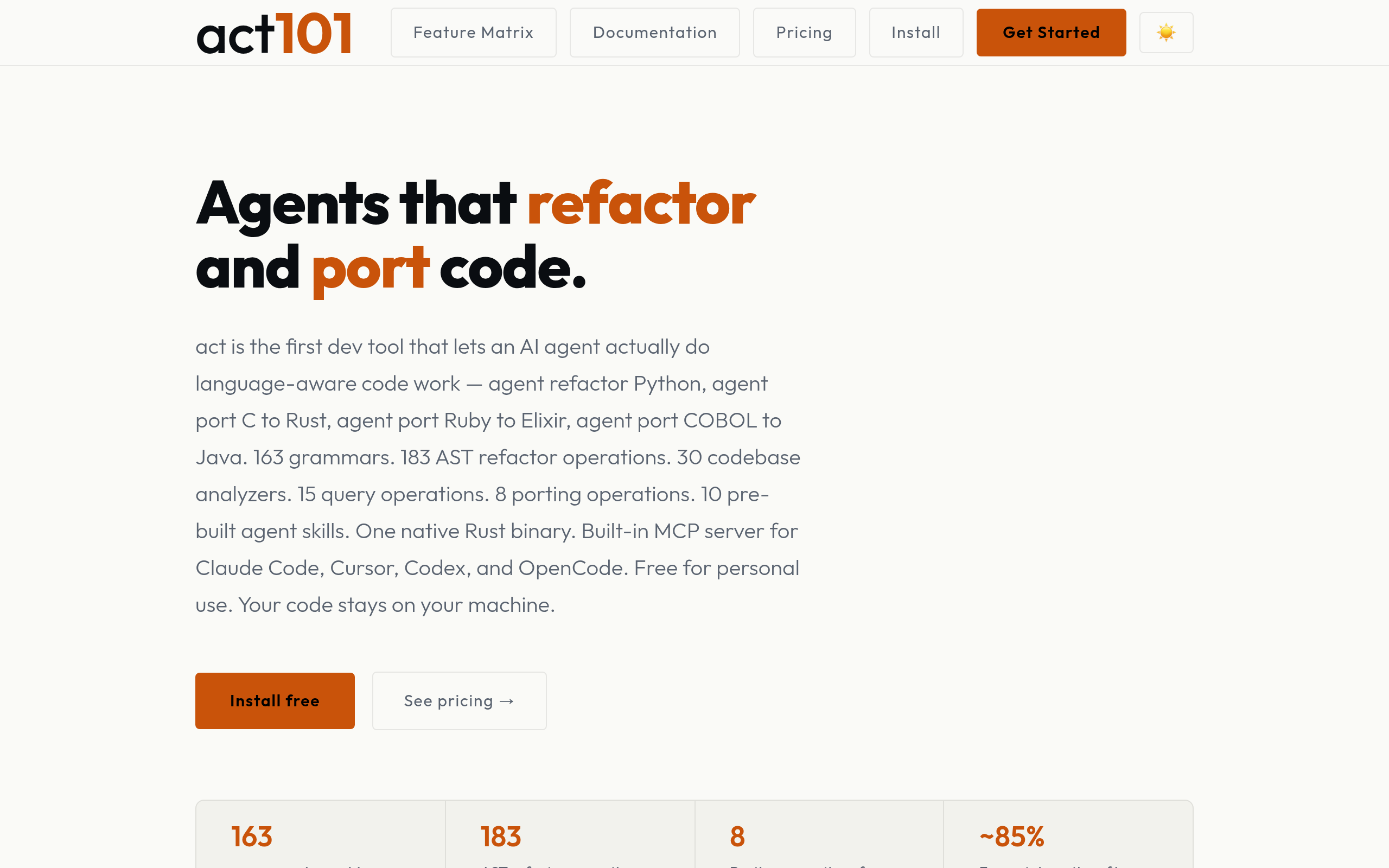
act101 — AI agents that refactor and port code across 163 languages The first dev tool that lets an AI agent actually refactor and port code. 163 grammars, 183 refactor operations, 30 analyzers, 8 porting ops — for Claude Code, Cursor, Codex, OpenCode via MCP. Agent refactor Python. Agent port C to Rust. Agent port Ruby to Elixir. 163 grammars, 183 refactor ops, 8 porting ops via MCP. Free for personal use. The first dev tool that lets an AI agent actually refactor and port code. 163 grammars, 183 AST refactor operations, 30 codebase analyzers, 8 porting operations — exposed to Claude Code, Cursor, Codex, and OpenCode through a built-in MCP server. Agent refactor Python. Agent port C to Rust. Agent port Ruby to Elixir.
Key Features
183 AST-aware Refactor Operations
Typed, AST-level operations (extract-function, rename, move-symbol, convert-to-dataclass, inline, etc.) that let agents make precise, cross-file edits without whole-file rewrites or lost comments.
Cross-language Porting Pipeline
End-to-end porting state machine (contract → inventory → ordering → manifest) with 8 porting operations to drive structured migrations between any of 163 grammars (e.g., C→Rust, Ruby→Elixir, COBOL→Java).
Codebase Analyzers and Query Operations
30 analyzers (coupling, cycles, dead code, hotspots, migration readiness, etc.) plus 15 query ops (references, callers, skeleton, graph, control_flow) so agents get a structural map before changing code.
MCP-native Local Server
One native Rust binary with a built-in MCP server (stdio and HTTP+SSE transports) that integrates with Claude Code, Cursor, Codex, OpenCode, and other MCP-aware clients while keeping code local.
Token-efficient, Safe Workflows
~85% fewer tokens vs file-based operations by returning AST-derived slices, with automatic checkpointing and instant undo for each operation to safely review agent changes.
How to Use act101
1) Install the act binary on your machine (download from the website or package manager). 2) Start the MCP server: use `act mcp serve` for stdio clients (e.g., Claude Code) or `act mcp http` for HTTP+SSE web clients. 3) Connect your MCP-aware agent (Claude Code, Cursor, Codex, OpenCode) and invoke operations or pre-built skills (e.g., /refactoring, /migration-assessment). 4) Review agent-suggested AST operations in the checkpointed workspace; approve, undo, or iterate until you’re satisfied.